
Walk onto enough foundation drilling job sites and you’ll see the same mistake made in different ways: the wrong tool in the ground for the conditions at hand. Sometimes it’s a scheduling decision, sometimes it’s what was available on the truck, and sometimes it’s just a habit. Whatever the reason, running the wrong tooling costs time, accelerates wear, and can compromise the borehole before the crew even realizes what’s happening.
Augers and core barrels are both built to create boreholes, but they work differently, and the conditions that suit one can be exactly the conditions that punish the other.
How an Auger Works
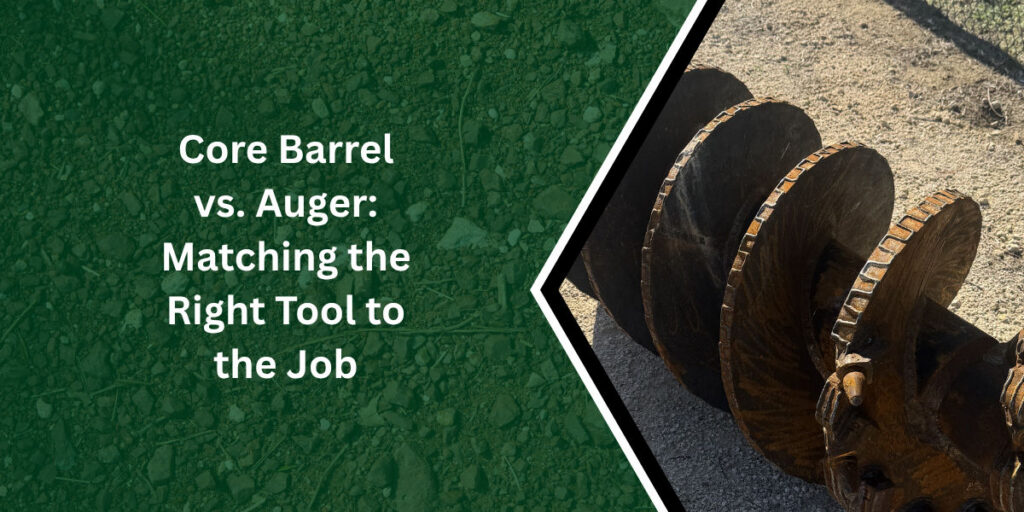
An auger cuts and removes material by rotating a helical flight that carries spoil up and out of the borehole. It’s fast, efficient, and purpose-built for soils that can be displaced without much resistance. Clay, loose sand, soft mixed soils, these are auger territory. In the right conditions, a good auger moves quickly and leaves a clean, consistent hole.
The limitation shows up when the formation changes. In hard rock, heavily cemented soils, or cobbled ground, an auger loses its advantage fast. The flights can’t move material that won’t break cleanly, penetration slows dramatically, and the tooling takes wear it wasn’t designed to absorb. Pushing an auger through conditions it’s not built for doesn’t just slow the job down, it shortens the life of the tool and puts unnecessary load on the rest of the rig.
Where Core Barrels Take Over
A core barrel is built for what an auger can’t handle. Rather than removing material continuously, it cuts a cylindrical core through rock or heavily compacted ground, capturing material inside the barrel until it’s lifted and cleaned out. It’s slower by design, but in hard or abrasive formations, it’s the tool that actually gets the job done without destroying itself in the process.
Core barrels are also the right call when borehole integrity is a priority in difficult ground. Because they aren’t relying on the formation to support itself during drilling, they tend to produce a more controlled, consistent diameter in conditions where an auger would be struggling to maintain wall stability.
The Decision Isn’t Always Obvious
Mixed formations are where tooling decisions get complicated. A site that starts in clay and transitions into weathered rock halfway down the borehole depth requires flexibility, and crews that plan for one condition and encounter another mid-job have to make a call quickly. Knowing the subsurface profile before the rig rolls in is the cleanest way to make sure the right tool is on-site, but having access to both options is what gives a crew the ability to adapt when the ground doesn’t cooperate with the plan.
Soil reports and geotechnical data should be driving tooling decisions before the job starts. When that information isn’t available or the formation surprises you, recognizing the signs that you’re in the wrong tool early saves a lot of wear and a lot of time.
Having the Right Inventory When It Matters
Titan Foundation Equipment stocks both augers and core barrels built for efficiency and durability across a range of ground conditions, along with the auger and core barrel teeth to keep them cutting at full performance. Whether you’re planning ahead for an upcoming project or need to replace tooling that’s reached the end of its service life, we can help you get the right equipment in hand without unnecessary delays.
Reach out through our contact page or call us at 30-RENT-A-RIG and we’ll help you figure out what you need before the next job gets started.