
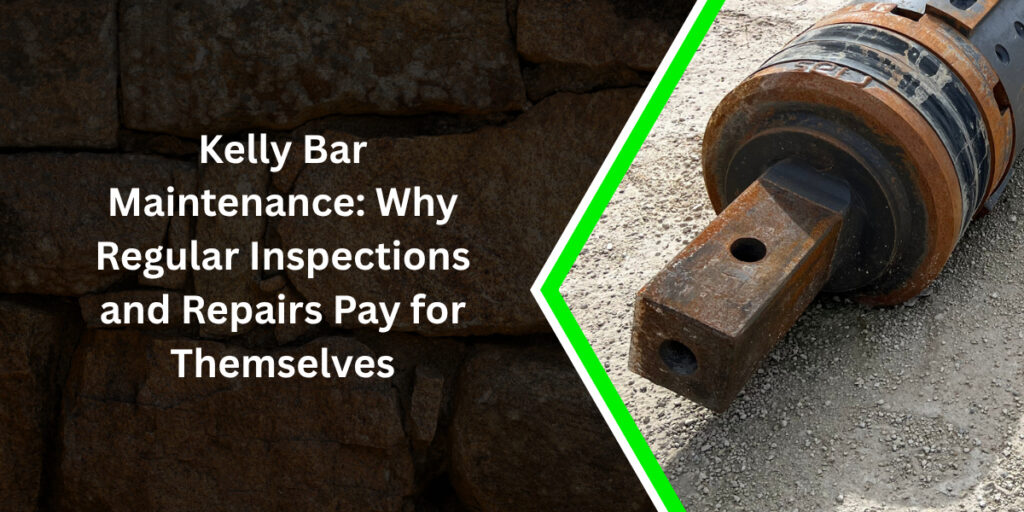
Ask any foundation drilling crew what part of the rig they worry about most, and the Kelly bar is going to come up fast. It’s the workhorse of the whole operation, the telescoping shaft that transfers torque from the rotary down to the tool, taking the full punishment of every shaft you drill. When a Kelly bar is in good shape, nobody thinks about it. When it isn’t, it can shut down a project in a hurry and cost a lot more to fix than it would have to maintain. At Titan Foundation Equipment, we see both ends of that spectrum, and the difference almost always comes down to whether a contractor has a real maintenance routine in place.
What Actually Wears Out on a Kelly Bar
Kelly bars look simple from the outside, but there’s a lot going on inside. The drive keys take constant impact loads, the inner sections slide against the outer sections thousands of times per shift, and the locking mechanisms (the canisters, latches, and pins) absorb shock every time the bar engages. Add in the abrasive material that finds its way into every joint and seal, and you’ve got a component that’s designed to wear. The question isn’t whether it’ll need attention. The question is whether you catch it on your schedule or on the jobsite’s.
The most common issues we see are worn drive keys, fatigued or cracked locking canisters, scored sliding surfaces, and damaged latches. Any one of these can progress from a minor annoyance to a full failure faster than people expect, especially on high-torque work in tough ground.
The Cost of Skipping Maintenance
A Kelly bar failure rarely happens in isolation. When a canister cracks or a drive key shears off mid-shaft, you’re often dealing with secondary damage to the rotary, the tool, or the bar itself. What might have been a routine inspection and a part swap turns into a major repair, plus the downtime, plus the crew sitting idle, plus whatever your contract says about missed completion dates.
We’ve talked before about the real cost of downtime in foundation work, and Kelly bar failures are one of the clearest examples. A canister you could have replaced in a day during a planned break becomes a week-long repair when it lets go in the middle of a shaft. The math on preventive maintenance almost always wins, and the contractors who treat it as non-negotiable are the ones who hit their schedules.
What a Good Maintenance Routine Looks Like
Regular Kelly bar care doesn’t have to be complicated, but it does have to be consistent. At minimum, that means visual inspections at the start of each shift for obvious cracks, deformation, or excessive play; greasing on the schedule the manufacturer specifies, not whenever someone remembers; and a more detailed inspection (keys, canisters, latches, and sliding surfaces) between major projects or at fixed service intervals.
Keep an eye on how the bar is performing in the cut. Unusual vibration, slower advance rates, or new noises during extension and retraction are early warning signs worth investigating before they become failures. Crews that run the same bar every day pick up on these changes faster than anyone, which is why operator feedback is one of the most valuable pieces of any maintenance program.
Why In-House Kelly Bar Repair Matters
When something does need attention, where you send the bar matters as much as how quickly you catch the problem. Shipping a Kelly bar out to a distant shop adds weeks to the turnaround, and not every repair facility has the experience to do the work right. A poorly repaired bar will fail again, usually at the worst possible moment.
Titan handles Kelly bar repairs in-house at our Texas facility, which means faster turnaround and direct accountability for the work. We stock canisters for most common repairs across the major brands (IMT, CZM, Soilmec, HPM) and we can build replacement parts for less common configurations when stock isn’t an option. If you need a full bar rebuild, that’s something we do too.
Get Ahead of the Problem
The best Kelly bar repair is the one you schedule before a failure forces it. Whether you need a routine inspection, replacement canisters and wear parts on the shelf, or a full repair on a bar that’s already given up, our team is ready to help you get the rig back in the cut and keep it there.
Contact Titan Foundation Equipment to talk through your Kelly bar service needs, or browse our parts inventory to see what’s ready to ship today.